
The Techification of Outside
How a prestigious magazine became a multi-media technology conglomerate

A few months ago, I started seeing paid ads on my social media feeds for an upcoming music festival in Denver called Outside Days. As an outdoorsy person who writes about outdoorsy things and follows outdoorsy accounts, it made sense that I would be targeted for an outdoorsy festival. The more I scrolled the trendy event page, the less I understood what the event even was: a tech conference? A music festival? A networking event? It was promising to be everything to every outdoorsy person, yet somehow, still didn’t feel like a fit for me. Among the myriad of information about climbing walls and executive speakers, at the very bottom below the sponsors – Capital One and REI top billed – was a link to the “sister site,” Outside Magazine.
Outside Magazine published articles that launched nationally-acclaimed books like Into Thin Air and The Perfect Storm and movie adaptations like Blue Crush and Into the Wild. I was 14 when I read Into the Wild for the first time. The descriptions of endless Alaskan landscapes inspired terror and awe in me. Over the years, I consumed the tale in all of its formats, finding me at different times from rebellious teenager to an adult fulfilling the dream of living alone in the wild. I wouldn’t have called the story aspirational – more like cautious advisory. But it spoke to me nonetheless.
Krakauer never invited people to hike into the wilderness, rather inside the mind of a young adventurer to explore the question, “Why are some people called to the wild?” He never encouraged anyone to visit Bus 142, the site where 24-year-old Chris McCandless survived until he couldn’t anymore, yet hundreds of people every year attempted to find it; two people died on the trek, prompting the national guard to remove the bus from the wilderness in 2020. One article could spur an entire movement: that was the complicated power of Outside Magazine.
So how the hell did an award-winning outdoor recreation magazine become a tech conference? And more importantly, should I go?
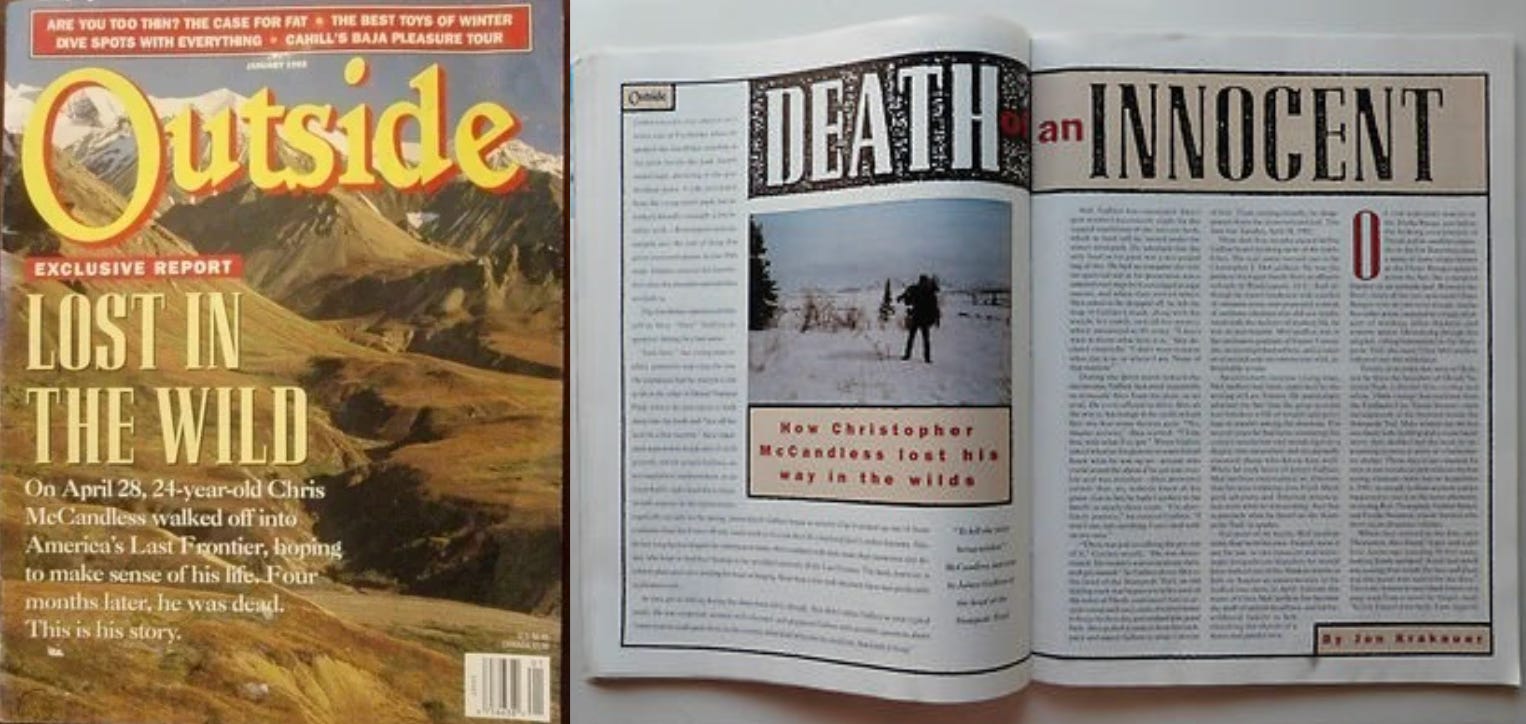
Two years after being founded by Rolling Stone founder Jann Wenner, Outside Magazine was sold to Larry Burke. Burke was not a hardscrabble Westerner, rather an adventurous traveler who’d spent five years vagabonding around remote parts of Africa, South America, the Middle East, and Russia. Returned, he started his own quarterly magazine to write about outdoor adventure as he and his friends experienced it — daring, uncharted, and perhaps ill-advised. With an offer to buy Outside the table, Burke merged the two into one publication, and Outside Magazine would develop under Burke for the next 42 years.
Unlike similar magazines like Field and Stream, which focused on pure sport, or National Geographic, which was more scientific, Outside wanted to focus on outdoor adventure that was literary, but not self-serious. Throughout the 1980s and 1990s, Outside published stories rooted in first-person experience like interviewing the first female matador in Spain or reporting the tale of how fishermen in Massachusetts ended up in “the perfect storm.” The stories were contrarian and nuanced, but not without commercial appeal; according to former staffers, Burke was critical of “hippies, dirtbag climbers, and environmentalists.” Still, Outside thrilled its readers with stories of being so deep into the wilderness that the modern world could ever reach you.
Even in its heyday, the magazine was not without its criticisms, particularly for popularizing isolated nature and selling readers on attempting reckless outdoor adventures. For example, when Jon Krakauer wrote a harrowing story of an Everest ascent gone wrong, demand for guided Everest trips doubled within four years. And in a magazine that advertises mountaineering gear, even the best-written cautionary tale can read like a challenge to the magazine’s adventurous readers. When criticized for catering to “young, urban professionals” looking to “‘buy’ the outdoor experience,” 1995 editor Greg Cliburn responded, “Mountain-biking does have a high potential to be destructive, but isn’t it better than gambling or drinking? Let’s put things in perspective.” Still, Outside reached new levels of prestige by winning a National Magazine Award for General Excellence in 1996, 1997, and 1998. Jon Krakauer himself won a National Magazine Award for his Everest piece “Into Thin Air” in 1997.
By the 2010s, Outside Magazine was struggling to keep advertisers in the internet age and, like most traditional publishers, needed a new revenue source or wealthy ownership (or, maybe, both). On one end, there’s Laurene Powell Jobs who owns The Atlantic but rarely gets involved in editorial; and on the other end, Jeff Bezos owns The Washington Post and has gotten aggressively involved. Or, there’s the The New York Times route by basically making money from a homemade gaming app. No matter what options are available, print magazines were and are struggling across the board. So it shouldn’t have been surprising when a tech entrepreneur sought to buy the magazine.
Robin Thurston started his career in wealth management helping rich people get richer. About 14 years in, he had one of those perfect place, perfect time kind of startup ideas while cycling in Switzerland: “What if I could record this ride and send it to a friend?” Two years later, the first iPhone came out, and MapMyRun and MapMyRide were number 98 and 99 in the app store. In an interview, Thurston described his business as “technology-first” and “constantly iterating” opposed to Under Armour – which acquired MapMy in 2013 – focused on physical products. It was a misalignment between the acquired company’s ethos and the new owner’s priorities. So, he left MapMy with Under Armour to start working on his next major undertaking: Outside, Inc.
Another bout of miraculous timing struck for Robin Thurston. According to research, he founded Pocket Outdoor Media as early as 2017; but it wasn’t until June 2020, at the height of the pandemic boom in outdoor recreation, that Thurston closed his first round of Series A funding. That was enough for the new entity to start buying outdoorsy brands to unite them under one “Amazon Prime for the active-life-style participant” — outdoor event management companies like Roll Massif, a cycling race series; fitness tracking like Fastest Known Time, a product that tracks race times; and niche publications like Yoga Journal, Vegetarian Times, and Backpacker. With the industry ballooning and another round of funding only eight months later, Thurston acquired his crown jewel, Outside Magazine, and renamed the conglomerate in its honor.
What does it mean to be the “Amazon Prime” for the “active-life-style-participant?” Why does that description feel so vague and detached? It’s this white whale goal that seemingly every company has in their never-ending quest for answers in the data. Thurston wants to know what products you purchased to run a marathon, what training program you used, what you ate that day, how fast you ran, if you shared any pictures on social media, what content you scrolled afterwards, and, maybe most importantly, what you’d pay to do again. The only way to do that, though, is by collecting data on every aspect of your outdoor life with technology. In this worldview, there are only two outcomes: bad technology, or good technology. There is no place for no technology outside.
The first year of ownership, Outside staffers had cautious optimism. With the influx of capital, freelancer debt was repaid. Diversity initiatives were instituted. They opened a new office in the heart of Boulder. Ideas were being thrown at the wall across all facets of the new company, from launching a new membership model to building an NFT marketplace. They continued acquiring companies, including buying MapMyFitness back from Under Armour. There was some downsizing and reorganizing, but the company was making big bets like launching Outside Festival, the “SXSW of outdoor culture.” Thurston saw the company as competing with “the most detrimental sort of health stuff in the world: our iPhones and screens.” With that sentiment, he echoes 1995 editor Greg Cliburn asking, “Isn’t the [destruction from mountain-biking] better than gambling or drinking? Let’s put things in perspective.” They aren’t technically wrong.
Technology has been forcing its way into every aspect of American life, and the great outdoors are no more safe from it. The reservation system Recreation.gov was created to centralize national park reservations, but recent reporting found that it’s teeming with bots, glitches, and led to more affluent visitors scoring the best spots. Thurston cites “friction” as a major issue for “outdoor enthusiasts,” claiming if there are too many steps to register for a marathon, you may just decide not to. But what happens when technology causes the friction, and wasn’t needed in the first place? And why do we think that more technology will fix the problems technology caused?
The big bets weren’t paying off fast enough for venture capital money to see returns. Merging websites caused internet traffic to plummet and glitched incessantly. Outside closed their Santa Fe office and moved everyone to Boulder. Workers briefly attempted to unionize, but when met with an “unusually aggressive anti-union campaign,” withdrew their election petition only to go through layoffs soon after. Months after the inaugural festival, the company had its third round of layoffs in three years. The entire Outside editorial team from before the acquisition either left, transitioned to non-editorial roles, or was laid off. In response to the layoffs, a group of well-known contributors signed a letter requesting their names be removed from the masthead for “destroying what Outside once stood for.” But that didn’t seem to stop Thurston, who continued investing in the festival, now entering its third summer this weekend.
Not only did the changes hurt morale, the quality of writing undoubtedly shifted. According to staffers, writers were discouraged from covering more stories about assault in the climbing community, or reporting on politics that painted Republicans in any negative light to appeal to as many potential customers as possible. In the endless grind for content, Outside was accused of stealing creators’ work. Staff no longer wrote for a single publication, rather were sorted into “content pods” organized by topic area, weakening the magazine’s cohesive voice. Thurston overwhelmingly refers to any writing within Outside, Inc. as “content” which just makes me cringe every time. Outside may have always encouraged its audience to buy into recreation, but its optimization has redesigned the whole entity to ensure you buy into recreation. The former informs the latter, but I’m not sure that the latter was inevitable.
As for the event itself: the first part is an industry conference with startups pitching for venture capital; a tourism forum focused on optimizing data; and a leadership summit including a talk between Robin Thurston and REI CEO Mary Beth Laughton, who you may recall from my piece last week about union busting. That starts at $467. The music lineup does look awesome, especially if you’re a Gen X man going through a midlife crisis in the great Denver metro area with $244 to kill. There will be outdoor celebrities like Alex Honnold, Olympians, content creators, and drag queen entertainment (though not Pattie Gonia, who recently went public about her trademark lawsuit with the corporation named after the same region in South America — and whose CEO will be speaking at the conference). It seems like anyone making money from people going outside will be there. If I were a better influencer, hell, I would be there too.
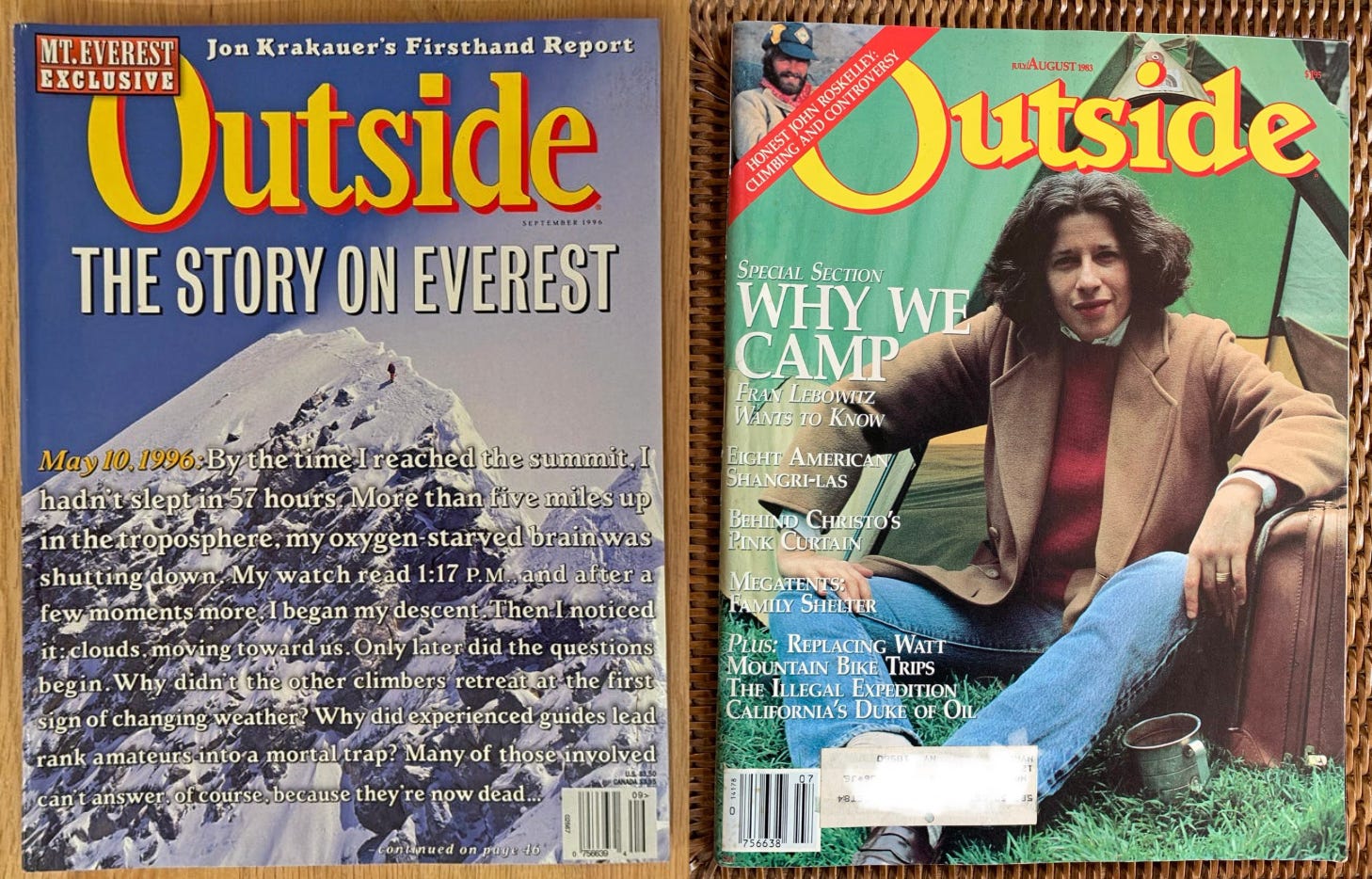
It’s been 30 years since Jon Krakauer survived Mount Everest. In 2026, overcrowding on Everest reached new dangerous peaks. Not only do hundreds of people ascend the summit every year, there are now luxury services complete with prepared meals and a “premium oxygen system.” Technology has made the trek so accessible that athletes have posted their time to the top on Strava. Krakauer has spent the last few months fighting defamation from an obsessed YouTuber claiming deliberate inaccuracies intended to sell Into Thin Air. But Krakauer doesn’t delude himself into thinking that ascending Everest was noble; instead, he openly regrets ever taking the trip at all. Still, everyone has to make a living — Krakauer is re-releasing the book for its 30th anniversary. And I’ll absolutely buy it.
The format has changed, the audience has shifted, but maybe this was always what Outside was meant to be — a way to sell the outdoor experience. As someone whose outdoor experience includes two years living entirely on free public land and sketchy parking lots, I just don’t think this version of it is for me. Targeted advertisement can’t work on a dirtbag. Instead of paying for Outside Days, I will be spending my weekend offline, actually outside.
Due to work and some of his friends, I was in a position to spend a weekend with Outside founder Larry Burke. Based on what I saw, I am not sure Outside changed as much as the world forced it to change? (Somehow said in the form of a question.) Meaning at the time Outside was really profitable because they had a product and people paid premium for it. Now, that product is worth less-so the company has to change to the consumers demands. And just because it is different, does not mean it does not have a market.
No 1, I am not an expert in ths category.
No 2, I canceled my subscription to Outside after about 15 years because the magazine became redundant and I lost interest in the content.
No 3, this seems to be the way to world is evolving. And as long as their are consumers-companies will adapt to find amd maximize their profit.