
Boycotting REI
How the co-op made a mess of its own morality (and where to shop Memorial Day Weekend instead)

Memorial Day Weekend is the official start to summer and, more importantly, outdoor recreation season. Around this time, everyone from crunchy van-lifers to high-tech mountaineers look to pre-summer sales, and no retail behemoth looms as large as Recreational Equipment, Inc., or REI. Gear-heads and dirtbags alike flock to REI for advice from experts, a fair range of prices, and the assurance that they’re making an ethical choice. But this year, customers are being asked to make a different ethical decision: boycotting the biggest sale of the year, and its own workers are leading the charge.
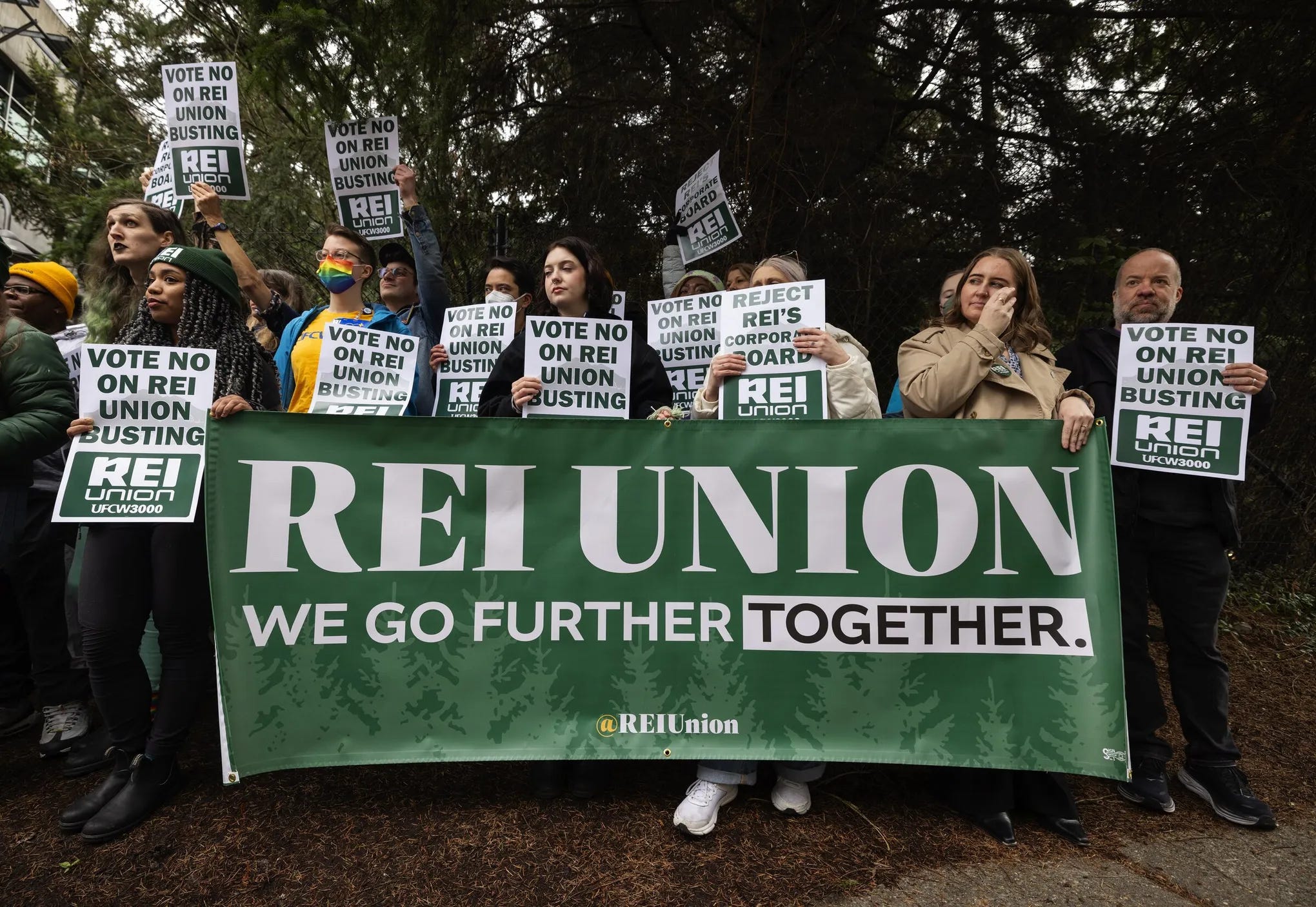
Four years of negotiations between management and the REI Union ended in an impasse after the union overwhelmingly rejected the company’s “last, best, and final offer.” A week later, the union voted to authorize a 10-day boycott during its high-profile anniversary sale and is encouraging customers to withhold their money in solidarity. It’s a blow for their CEO Mary Beth Laughton, barely a year into her tenure after inheriting eleven newly unionized stores and three planned closures. For the workers, the boycott isn’t just about financial damages — it’s about standing on principles. As a cooperative, REI has a responsibility not to stockholders, but to its customers. To understand how the ethical darling of the outdoorsy world created a mess of its own morality, you have to go back to where it all started: “the Soviet Republic of the state of Washington.”
That’s what newspapers called the Seattle General Strike of 1919. Lloyd and Mary Anderson were teenagers in Washington when 65,000 workers went on the five-day general strike. At the end of WWI, shipyard workers demanded a return to pre-war wages and other unions walked out in support. Labor unions were strong in the Pacific Northwest and, leading into the Great Depression, cooperatives became popular alternatives for economic support. So in 1938, when married mountaineers Lloyd and Mary wanted a way to cheaper ice axes directly from a manufacturer, they asked five of their friends to pay-in $1 to purchase a small inventory and sold them on a shelf of the Puget Sound Cooperative Store. Thus, the REI Co-op was born.
A cooperative is a jointly-owned entity where members vote democratically on decisions. A worker co-op is owned by employees; a housing co-op is owned by the residents; and a consumer co-op is owned by the customers. Two major components of a co-op are member economic participation, including profit sharing, and member control, like voting on board decisions. When the co-op has a surplus, the members vote on what to do with it, like investing it back into the co-op or paying out profit dividends. When co-ops grow too large, members can elect representatives to vote for their interest and can form unions within the co-op to advocate for their rights.
REI’s operations within its first decade outgrew its singular shelf into more retail space and hired their first full-time worker, Jim Whittaker. In 1963, Jim became the first American to summit Mount Everest, giving REI - and mountaineering broadly - enough free publicity to open its first store. In 1971, Jim became REI’s chief executive, and despite internal opposition, sought to broaden the retailer beyond Seattle, opening a second location in Berkeley in 1975. Conversely, when the board wanted to scale into other outdoor recreation, Jim wanted to keep the focus on serious mountaineering. After disagreements over depth versus breadth, he retired, finding more financial success in endorsing products than running a company. But expansion was already in motion.


Specificity or broad appeal? Hyper-niche or for the masses? Gatekeeping or open access? This tension has been at the core of nearly every heated debate about the great outdoors. There was a time when environmentalists protested the construction of paved roads through national parks to forgo public accessibility; on the other hand, some have argued that nature should be untouched by humans, a reality which has never really existed. Both sides are right but neither are fully correct, you know? This is all to say that the issue changes with its context. So when a company like REI expands into new markets and industries, it’s within the context to both expand access to more people and to expand its customer base. Just in time for capitalism to really pop off.
1980: REI started the decade with 1 million members and 6 retail locations, opening 2 to 3 stores per year. They expanded to camping and cycling, acquired manufacturing companies to produce their own gear, and launched REI Adventures in 1987 to lead outdoor vacations and educational tours. These decisions ensured that REI would maintain their speciality knowledge as they continued to grow. They dropped the “co-op” from their branding to appeal to an even broader audience removed from its Seattle roots, but stayed committed to its ethics by launching initiatives to fund public lands projects and protect wilderness areas. It officially became the largest cooperative in America. Through the late 1990s, REI reached its peak balance of depth and breadth with the launch of REI.com and the opening of its Seattle flagship store, complete with climbing wall, bike trail, and rain room to test out gear. The internet gave REI reach to people where retail stores couldn’t go, and the retail stores offered an expert experience only found at REI.
While competitors like Dick’s Sporting Goods offered cheaper prices (and therefore lower wages), REI touted its ability to provide affordable gear with expertise. REI couldn’t just expect new customers in each new market – it had to educate more potential buyers. The day hiker was just an entry-level mountaineer. The right piece of gear would not only feel exciting to use, it would come with professional assurance everything they needed to conquer their goals was right there in store. Salespeople had to have outdoor experience and local knowledge from former park rangers, to multi-thru-hikers, to river guides who were encouraged to take multiple kayaks out onto the water to try them out before giving advice. Unlike the average retail employee, many workers built specialized careers around the REI ecosystem from bike technicians to expedition leaders.
REI understood that its key demographics were aging as they approached the new millennium; they had to start reaching a younger audience. After a shaky start to the 2000s with the opening and immediate closure of the first international store in Tokyo (because what else says “I’m going through an aging crisis” like a trip to Japan?), the company leveled to a steady growth under CEO Sally Jewell. The retail design became more standard and efficient to open, but still maintained a focus on outdoor hegemony, including opening the SoHo flagship in 2011. Jewell invested in more outdoor programs for youths, particularly in cities where young people lacked access to nature. In 2013, she was tapped to join the Obama Administration as U.S. Secretary of the Interior, and her successor take the next big steps to engage REI’s younger, more socially progressive audience.
Ah, the millennial optimism of the Obama years. Truly, you had to be there to get it. Hope, change, and diversity championed any conversation. Through the internet and social media, young people had a direct line to the political class and challenged the progress made through a different lens. Little by little, corporations got the sense that the young people they’d been investing in cared not just about outdoor access, but equitable access. This led to some meaningful improvements to REI’s ethos, and some less meaningful, like putting a rainbow on every item they could sell.
Jewell’s replacement Jerry Stritzke came from a conventional retail background, first at Gap, then at luxury brand Coach. He leaned heavily into the identity politics of the era to evoke REI’s radical roots. They brought back the term “co-op” into their branding for the first time since the ‘80s and launched the #OptOutside campaign, closing stores and giving retail workers Black Friday off. This is also around the time that REI workers started discussions on Facebook pages about liveable wages in the increasingly expensive tech bubble of the Pacific Northwest. Stritzke’s track record was relatively good, even as discontent started brewing, until early 2019 when the company announced he would be stepping down due to an investigation finding he had an “undisclosed, consensual relationship” with “another leader in the outdoor industry.” (No; I’ve dug, and no one seems to know who it was.) So, after a two-month interim period, REI’s internal operator Eric Artz took over as CEO, months ahead of the global pandemic.


Something to note here is that much like Obama’s progressive glow, the military industrial complex was quietly funding things from behind the curtain. Underpinning the outdoor recreational industry is a bigger, quieter customer: the US military. Companies that produce high-quality, specialized active wear can meet the procurement needs of special ops. As Avery Trufelman found while investigating the military origins of “Gorpcore,” manufacturers like Outdoor Research sell directly to a recreational audience and a tactical one. When the military is preparing for or actively fighting a war, there is approved money to spend on new gear, and business is good. But when the fighting is over, like when the War in Afghanistan finally ended in 2021, business is bad. War is good for the outdoor recreation industry, like it’s good for most capitalistic endeavors.
Before he was the CEO, COO, and CFO of REI, Eric Artz was first in the army. When the pandemic temporarily closed retail stores a year into his tenure, there were big gestures from leadership, like the board and Artz forgoing compensation for six months — which, according to financial records, still netted Artz nearly $2 million in 2020 as opposed to his salary the year prior, $3.2 million — and maintaining health benefits for furloughed workers through July 2020 when stores slowly started opening again. The pandemic was also good for the outdoor business and REI reported record profits in 2021. Some workers protested the lifted masking requirements and voiced safety concerns, but all things considered, REI was looking to have made it out of the worst of the pandemic retail slump. Mission accomplished.
But something happened in 2022. Amid a wave of labor wins in New York, the SoHo flagship was the first store to unionize. On the same day, REI relaunched its co-op membership program: the one-time fee raised from $20 to $30; they closed their secondhand gear program to the public, for members only; and they no longer paid out cash dividends, only offering members the option to redeem on “eligible purchases” at REI. Immediately following the union vote, REI raised its minimum hourly wage nationwide — except for the SoHo store. REI abandoned the #OptOutside campaign and opened on Black Friday again. Amid labor negotiations, REI quietly stopped releasing its annual executive compensation report to the public. Union-busting tactics like mandatory management meetings, withholding raises and bonuses, and intimidating organizers didn’t seem to stick as ten more stores voted to unionize over the next three years. Ski and bike shop workers walked out of the SoHo store to protest safety conditions in their basement ventilation. To round out his tenure as CEO, Artz announced the closure of REI Adventures and three stores, two of which were unionized, including the SoHo flagship.
From the outside, there can be this idea that unions are a mob of animosity with unreasonable demands. REI was already progressive and paid better than minimum wage; what could employees possibly want more of? But the REI Union’s primary ask is for more consistent scheduling so workers don’t find themselves with zero hours scheduled without warning and no ability to pay rent. Generally, unions formalize the benefits workers already have by protecting them by law. They form after attempts to express concern are not taken seriously, and when the workers no longer trust that their company leadership has their best interests at heart. Companies have the ability to voluntarily recognize a labor union, yet waste millions of dollars on union-busting lawyers instead regaining the trust of its workers. And as someone who’s lived through a union fight, trust me: the company lawyers are always more animus.


When Nike executive Mary Beth Laughton assumed her CEO responsibilities in March 2025, she must have known she was walking into a shitshow. During the annual board of directors election two months later, the union successfully urged co-op members to reject REI’s selected board nominees. Laughton had to publicly walk back REI’s endorsement of Trump’s pick for Interior Secretary after member outrage. There was hope, though, when she went to the bargaining table in July and came to a temporary arrangement with the union, who signed a non-disparaging agreement for the six months of negotiations and board elections. Maybe REI was finally ready to live up to its principles, get back to its roots, and treat the experts they’ve cultivated with dignity. Maybe they were ready to be a real cooperative again.
In February 2026, REI management gave the union its “last, best, and final offer,” and workers across all 11 unionized stores voted 98.% to reject. They’d reached an impasse. After internal deliberation, the union voted again, this time to boycott during REI’s ten day annual sale. The union isn’t asking people to abandon REI forever; instead, to join the 70,000 co-op members exercising what little democratic muscles are still left. After decades chipping away at Lloyd and Mary Anderson’s humble co-op beginnings, REI now stands at its most crucial crosspoint. Will they finally get the message to get back to their roots, or find ever-lower grounds to sink?
There are other ways to gear up for a summer outdoors this Memorial Day Weekend. One option is to buy directly from independent companies that sell at REI, like Toad&Co, Big Agnes, and the Landmark Project, all having sales. Larger private companies like Patagonia, Cotopaxi, and Burton are still rated highly for labor rights and environmental standards, and each have their own resale websites. Buying second-hand gear is my preferred option, either online at Gear Trade or, even better, at your favorite local secondhand shop, like mine, Secondwind Atlanta.
When asked why he didn’t just set up his own for-profit company, Lloyd Anderson said, “I wouldn’t want to make money off my friends.” There is no way to go back to those better times when hope was cool and interior secretaries were environmentalists and an ice axe only cost $3 among friends. But there is a way forward, if only for a little more cooperation.
Additional sources:
https://inthesetimes.com/article/starbucks-trader-joes-rei-union-labor-nlrb-first-contract
Excellent as always
Wow! Really great in-depth history of REI's start to where it is today. Ironic that current leadership is completely going against the founders' principles.